 Cubesite
2026-03-07
Four Attribution Blind Spots That Cost D2C Brands Crores
Your campaign dashboards show green. Your spend is still wasted. Here are the four attribution blind spots hiding in plain sight.
Loading article...
2026-03-07
Your campaign dashboards show green. Your spend is still wasted. Here are the four attribution blind spots hiding in plain sight.
Loading article...
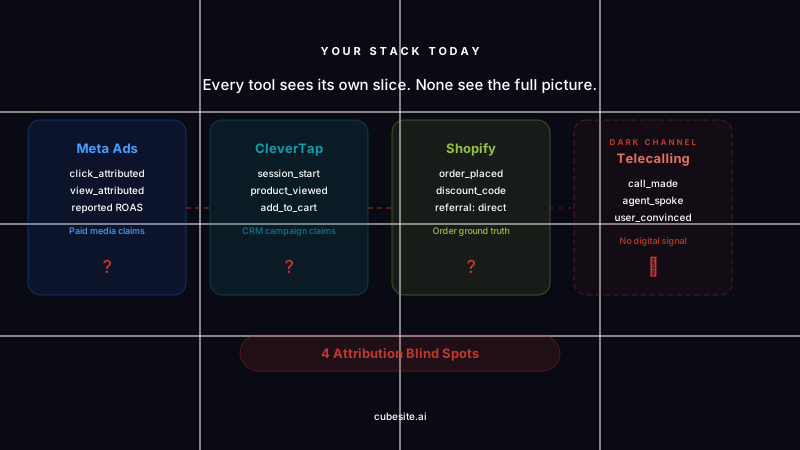
D2C brands today operate across a growing stack of disconnected tools, and marketers broadly are using only one-third of their martech stack's capability (Gartner, 2023, via Martech.org). Each tool holds a piece of the revenue picture. Very few hold enough context to explain the whole outcome on their own.
The result isn't just fragmentation. It's something more specific and more expensive: attribution blind spots. Gaps where intent data never reaches campaign targeting, where credit is assigned without causality, and where discount spend accumulates with no signal of whether it was ever needed.
Brands can see what happened. They cannot see why, or what it actually cost.
| Metric | What dashboards say | What the data actually shows | Source |
|---|---|---|---|
| Incremental ROAS | Platform-reported ROAS | Stella's 225 geo-tests found a median iROAS of 2.31x | Stella DTC Benchmarks, 225 geo-tests, 2025 |
| Cross-channel efficiency | "Spend is optimised" | Ruler cites 15-30% efficiency gains when teams use attribution across channels | Ruler Analytics, 2025 |
| Cart abandonment | Visible in analytics | Baymard's current average documented online cart abandonment rate is 70.22% | Baymard Institute, 50 studies |
| Scale plateau | Growth plateaus | Around 60-65% of Indian D2C brands remain in the ₹1-50 crore revenue band | DSG / Meta / Viralmint, reported by Entrepreneur India, 2025 |
Attribution blind spots are rarely just a dashboard problem. They are usually a join problem, and some channels stay invisible until their data is stitched back in.
Many Indian D2C brands run on some version of this stack: an ad platform (Meta Ads, Google Ads) for paid acquisition, a CRM or engagement tool (CleverTap, MoEngage, WebEngage) for retention and campaign automation, an ecommerce platform (Shopify, WooCommerce) that holds actual order data, and often an outbound calling operation running in parallel. Each system reports its own slice of performance. The blind spots show up in the overlap.
Ad platforms track who saw a campaign, who clicked, and who later converted using their own attribution settings. In practice, Meta reporting commonly uses click/view windows such as 7-day click and 1-day view, while Google Ads now defaults most conversion actions to data-driven attribution. Both are designed to decide how much credit the platform should take for a conversion.
What they miss: What the user was doing before the ad was served and what else happened around it. If someone added a product to cart on Tuesday, browsed again on Wednesday, and then saw a retargeting ad on Thursday before buying, the ad platform can take credit inside its own reporting window. It does not automatically know the user was already high intent, or that your CRM tool may have sent a push notification the day before.
Your CRM or engagement tool often has one of the richest first-party datasets in the stack. It tracks events like session_start, product_viewed, add_to_cart, and checkout_initiated, and uses that history to trigger campaigns: push notifications, in-app messages, email and SMS flows. When a user converts after receiving one of those campaigns, the platform may attribute the sale to that campaign according to its own rules.
What it misses: What was happening in the paid media layer at the same time. Your CRM tool often won't know that same user also clicked a Meta retargeting ad this week. So when that user converts, both your ad platform and your CRM can claim the win. If you add those conversions up naively, the combined total can exceed your actual order count.
Your ecommerce platform, whether that's your own Shopify store, Amazon, Blinkit, Nykaa, or Myntra, records what actually happened: the order, the amount, the SKU, and in some cases the discount code used. It is one source of revenue ground truth in your stack. If you sell across multiple platforms, you now have multiple fragments of that truth.
What it misses: The journey that led there. Shopify's native reporting can tell you the referrer or landing page, but it rarely reconstructs the full cross-channel path that created the order. Marketplace and quick-commerce order feeds often expose even less customer-journey detail, and campaign-level linkage is usually partial or absent. A user who saw your Meta ad, received a CleverTap push, and then ordered on Blinkit can still end up as three disconnected records with no shared campaign context.
Many D2C brands run an outbound calling team alongside their digital stack, with agents working off a list of cart-abandoners, lapsed users, or trial customers. The calls happen in Exotel, Knowlarity, or a basic CRM. Outcomes often get logged separately from the rest of marketing data.
What it misses: Joined context. Unless call logs are exported and stitched back to orders or CRM profiles, telecalling remains invisible to the rest of the attribution model. When a user who was called converts two days later, the sale is usually credited to whichever measurable digital touchpoint happened to come last, or simply to "direct." The call that influenced the outcome is easy to miss.
Most campaigns look fine in isolation. The numbers add up. The dashboard is green. The blind spots don't show up inside any single tool — they live in the gaps between them.
Blind Spot 1: Targeting that ignores intent. Your CRM or engagement stack can hold rich behavioural history: sessions, product views, cart adds. But that history does not always feed back into campaign targeting rules. When a discount campaign goes out to a broad segment, high-intent users who were already likely to buy get the same offer as users who needed the nudge. The cost of that mismatch is hard to see because few teams compare pre-campaign intent with post-campaign conversion.
Blind Spot 2: Attribution without causality. When a user converts, both your ad platform and your CRM claim credit. Meta counts it as a paid media conversion. CleverTap counts it as a CRM campaign conversion. Shopify records one order. Neither tool asks whether the conversion would have happened without the campaign — they are designed to claim credit, not to measure its absence. The result is inflated conversion counts, overstated ROAS, and playbooks built on false signal.
Blind Spot 3: Discount spend with no incrementality signal. Your finance team can see total discount code redemptions. They usually cannot see what share of those redemptions went to users who were already high intent or already in the cart. That number sits at the intersection of event history and order data. Neither tool surfaces it alone, and there's rarely a process that joins them.
Blind Spot 4: Telecalling as a dark channel. Many D2C brands run outbound calling campaigns: agents call cart-abandoners, lapsed customers, or trial users to answer questions and nudge a purchase. These calls happen in Exotel or Knowlarity, get logged in a spreadsheet or a basic CRM, and often never get stitched back into the broader marketing data model. When a user who was called buys two days later via the app, Shopify may log it as "direct." Meta may claim the retargeting impression. CleverTap may claim the push notification. The call that actually moved the needle can end up with zero credit, and the telecalling team gets evaluated on activity instead of revenue influence.
Most of the data to answer these questions already exists. The hard part is joining it, and telecalling stays invisible until call logs are treated as part of the measurement stack too.
The damage from attribution blind spots isn't a one-time cost. It compounds in four ways.
When high-intent users consistently receive discounts they didn't need, teams risk teaching customers to delay purchase until the next offer. Invesp's analysis of ecommerce discounting risks makes the broader point: blanket discounts can erode margin, cheapen perceived value, and reward the wrong segments. Even before you measure exact incrementality, the commercial risk is obvious.
If every "10% off" campaign shows 90+ conversions and green metrics, the growth team has no reason to question it. The playbook hardens. Budget allocation follows. Incrementality never enters the conversation because no tool surfaces it.
Because call-driven conversions are often attributed to the last measurable digital touch, telecalling can look unproductive on paper. Brands reduce calling budgets or cut the team without realising they may have removed the channel closing the fence-sitters. Digital spend stays flat or increases to compensate. Conversion rates quietly drop and nobody connects the two.
Stella's 2025 benchmarks found that across 225 geo-based incrementality tests, the median true incremental ROAS was 2.31x. For many teams, that is lower than the ROAS implied by platform attribution reports. That gap doesn't shrink on its own. It grows as campaigns scale and targeting stays broad.
The most expensive marketing mistake isn't a failed campaign. It's a successful-looking campaign that was never actually needed.
Closing attribution blind spots is a join problem, not a dashboard problem. No amount of better visualisation in CleverTap or sharper Meta reporting will solve it. The fix requires connecting four things that currently exist in separate systems, and sometimes outside the digital stack entirely:
1. Pre-campaign intent (from CleverTap / MoEngage): For each user who converted, what was their session count, product view frequency, and cart history before the campaign was sent? This determines whether the campaign caused the conversion or just preceded it.
2. Order truth (from Shopify / Amazon / Blinkit): What did they actually pay, on which platform, and was a discount applied? Brands selling across multiple channels need to consolidate order data from their own D2C store alongside marketplace and quick-commerce platforms — each of which holds a fragment of total revenue with no shared campaign context.
3. Campaign overlap (from Meta Ads / Google Ads): Which paid campaigns was this user exposed to in the same window? Cross-referencing CRM campaigns with paid media exposure is one practical way to reduce double-counting and understand which channel actually did the work.
4. Call logs (from Exotel / Knowlarity / your calling CRM): Was this user called before they converted? What was the disposition: did they pick up, did the agent speak to them, how long was the call? Joining call records to user phone numbers in Shopify or CleverTap is one practical way to bring telecalling out of the dark and into the attribution model.
When these are joined at the user level (via phone number, email, or order ID), the blind spots resolve:
This is what Cubesite does. It connects to your CleverTap instance, your Shopify store, and your Meta Ads account. It joins user-level behavioural data with actual order data and paid campaign data, then surfaces the blind spots in plain language.
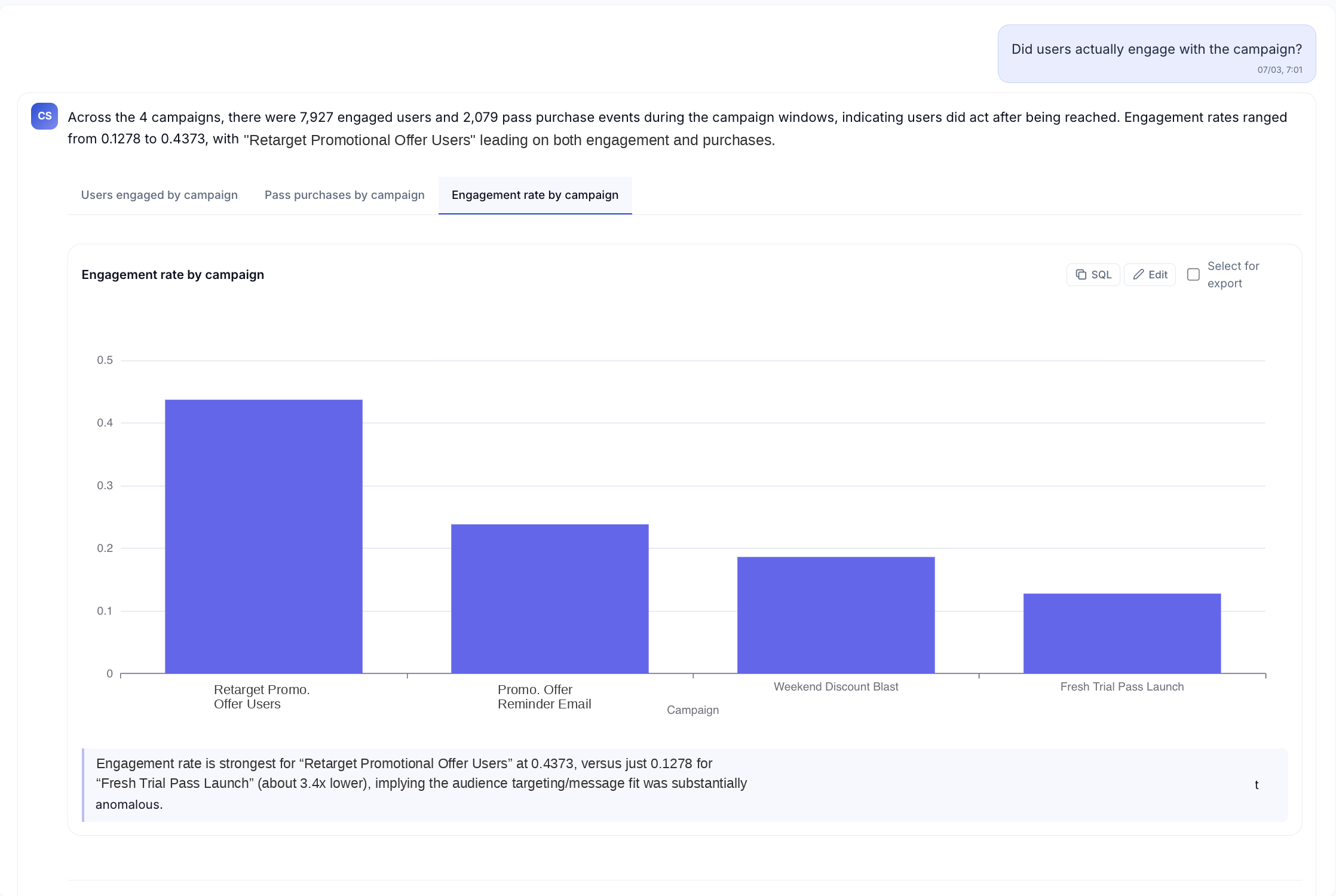
Instead of a dashboard, you get answers. For example, once the data is joined, you can ask questions like:
"Of the 94 SAVE10 converters in this campaign, 38 had 3+ product views and a cart add before the campaign. Their pre-campaign intent score was high. Excluding them would have saved roughly ₹12,540 in discount spend with no measurable revenue loss."
"Across your last 4 campaigns, 35 to 42% of discount redemptions went to users in the top intent quartile. Here's the segment definition to exclude them next time."
This isn't a reporting layer. It's a reasoning layer that joins the data your tools already have and surfaces what none of them can see alone.
Cubesite connects to your existing stack (CleverTap, Shopify, Meta Ads) and surfaces the attribution gaps your dashboards can't show. No new SDKs. No data migration. Ask your first question in plain English and get answers traced back to the raw data.